
Nordic-Baltic Hydrogen Corridor
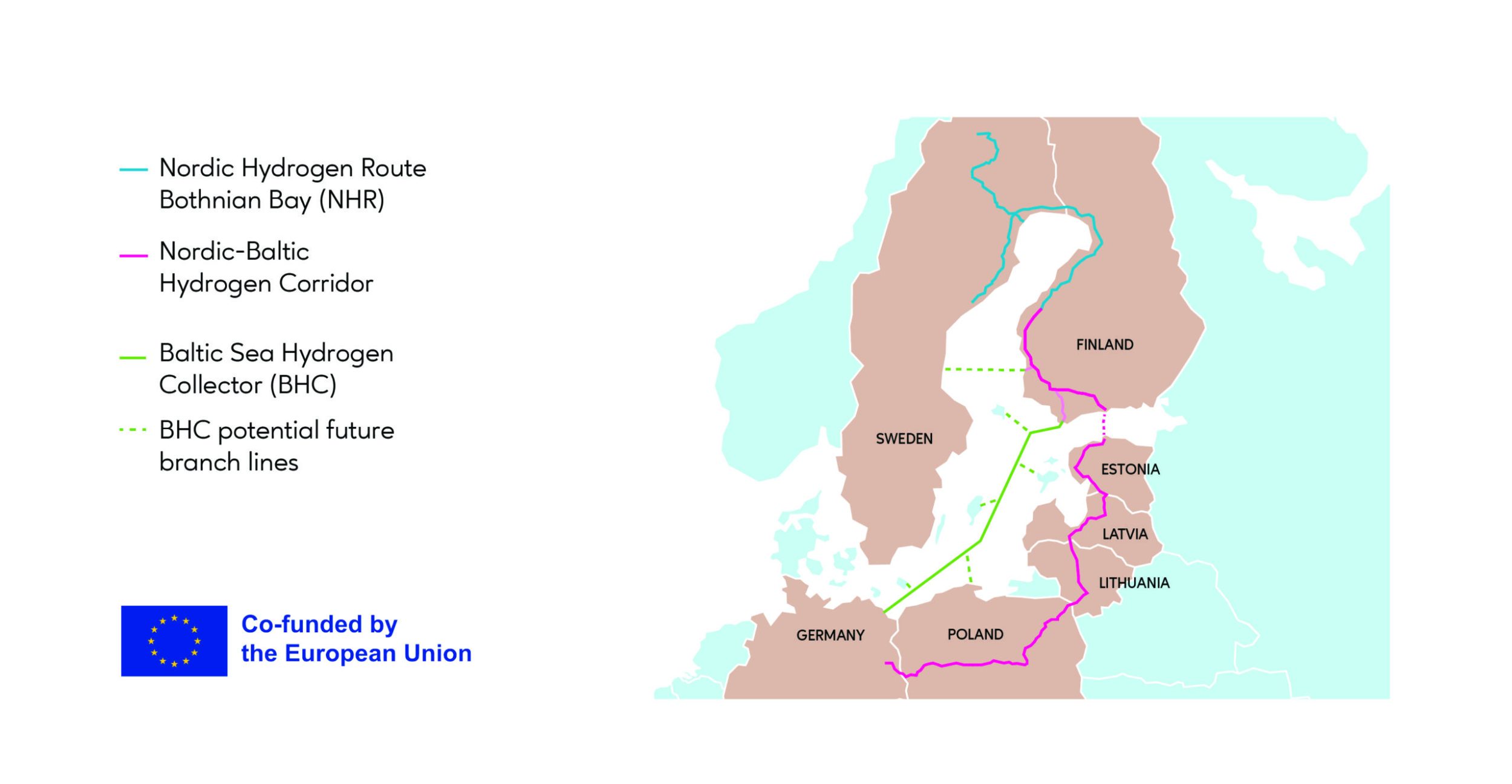
The Nordic-Baltic Hydrogen Corridor (NBHC) project aims to develop the hydrogen infrastructure from Finland through Estonia, Latvia, Lithuania and Poland to Germany in the first half of the 2030s. The aim is to transport renewable hydrogen between these six countries.
The parties to the project are transmission system operators: Gasgrid, (Finland), Elering (Estonia), Conexus Baltic Grid (Latvia), Amber Grid (Lithuania), Gaz System (Poland) and ONTRAS (German). Gasgrid’s role particularly relates to development of the hydrogen infrastructure covering the whole of Southern Finland and of the market in the Baltic Sea Region.
Call for Interest is open 14th January – 31st March 2026
We invite all interested stakeholders to participate in our non-binding Call for Interest. The purpose is to map market needs for cross-border hydrogen transmission infrastructure and to collect indicative, non-binding signals that inform routing and corridor design. You’ll find the formula here >>
Part of the EU’s hydrogen strategy and REPowerEU plan
The NBHC project promotes a sustainable energy economy and the EU’s transition to a cleaner energy system by combining clean hydrogen production and consumption in six Member States. It supports the achievement of both EU and regional climate goals and is part of the EU’s REPowerEU plan, which aims to diversify the EU’s energy sources, reduce energy consumption and accelerate the clean energy transition. The project is related to the EU Hydrogen Strategy, the EU Green Deal and the Fit for 55 package.
The pipeline will improve national security of supply and supply reliability as well as the diversity of supply in Europe. According to estimates, the pipeline to be built could at best reduce carbon dioxide emissions by up to 37 million carbon dioxide equivalent tonnes per year by 2050.
Project phases
The first phase of the NBHC project saw the commissioning of a prefeasibility study, which was completed in autumn 2024. Key takeaways from the prefeasibility study (PDF)(Opens in new tab). The prefeasibility stage was completed at the end of 2024. The prefeasibility study defined the key conditions for the implementation of the NBHC hydrogen pipeline. According to the prefeasibility study, the roughly 2,500-km long hydrogen pipeline could transport as much as 2.7 million tonnes (Mt) of renewable hydrogen between the countries by 2040.
The project has currently progressed to the feasibility study phase in 2025, for which EU CEF project funding has been received. During the feasibility study phase, the project will form an updated view of the technical solution for the pipeline and its commercial conditions. The project will also assess each national pipeline part separately, taking into account their specific national needs. The feasibility phase will continue until spring 2027.
Project granted EU PCI status and CEF support
In April 2024, the Nordic-Baltic Hydrogen Corridor project received EU Project of Common Interest (PCI) status. PCI projects aim to build more integrated and sustainable energy markets in the EU and support the achievement of energy and climate targets.
PCI status can be granted to projects that are key to the EU’s internal market energy systems and for the EU to reach its energy and climate policy objectives: affordable, reliable and sustainably-produced energy and a reduction in carbon dioxide emissions in line with the Paris Agreement. To obtain PCI status, projects must have a significant impact on the energy market and market integration in at least two EU Member States, increase competition on energy markets and enhance the security of supply of energy by, for example, integrating renewable energy sources.
PCI status enables simplified permit process and the possibility to apply for funding from the EU’s Connecting Europe Facility (CEF) programme. The project was granted total funding of EUR 6.8 million. Receiving the funding enables the project to proceed towards implementation and support the development of an EU-wide hydrogen economy.

- See more:
- The Nordic-Baltic Hydrogen Corridor launches Call for Interest to help shape a cross-border hydrogen pipeline
- Invitation to Hydrogen Market Participants: Join us to develop the Finnish and Baltic Sea Region Hydrogen Market Value Chains
- “Strategically crucial for the future of EU energy infrastructure” – Nordic-Baltic Hydrogen Corridor receives CEF funding 2 July 2025
- Press release 9 Sep 2024
- Key takeaways from the pre-feasibility study
- Press release 12 Apr 2024
- Press release 5 Jan 2024
- Press release 16 Dec 2022
- Project website
- Elering
- Conexus
- Amber Grid
- GAZ-SYSTEM S.A.
- ONTRAS
Schedule
text
Facts
text