
Nordic Hydrogen Route
Nordic Hydrogen Route is an initiative between Gasgrid Finland and Nordion Energi to accelerate the creation of a hydrogen economy by building up a cross-border hydrogen infrastructure in Bothnian Bay region and an open hydrogen market by 2030. The aim of Nordic Hydrogen Route is to drive decarbonization, support regional green industrialization, economic development, and European energy independence. The companies seek to develop a network of pipelines that would effectively transport energy from producers to consumers to ensure they have access to an open, reliable, and safe hydrogen market.
The Nordic Hydrogen Route will drive decarbonisation, support regional green industrialisation, economic development and European energy independence. In addition, Nordic Hydrogen Route will accelerate the creation of hydrogen economy and new investments to support European energy transition and increase the access to green and competitive domestic energy.
Project was granted EU's PCI status and CEF support
In April 2024, the Nordic Hydrogen Route project received the European Union’s Projects of Common Interest (PCI) status. PCI projects aim to build a more integrated and sustainable energy market in the EU and support the achievement of energy and climate objectives.
PCI status can be given to projects that are important to the European internal energy market and for the EU to achieve its energy and climate policy objectives: delivering affordable, secure and sustainable energy and reducing carbon dioxide emissions in accordance with the Paris Agreement. The projects must have a significant impact on the energy market and market integration in at least two EU Member States, increase competition on energy markets, and enhance the security of supply of energy by, for example, facilitating the integration of energy from renewable energy sources.
PCI status enables accelerated permit processes and the possibility to apply for the EU’s Connecting Europe Facility (CEF) financing. In 2025, the project was granted CEF support totalling EUR 29.4 million. Receiving the financing will allow the project to proceed towards implementation and support the development of an EU-wide hydrogen economy.
The project will next progress to the feasibility phase.

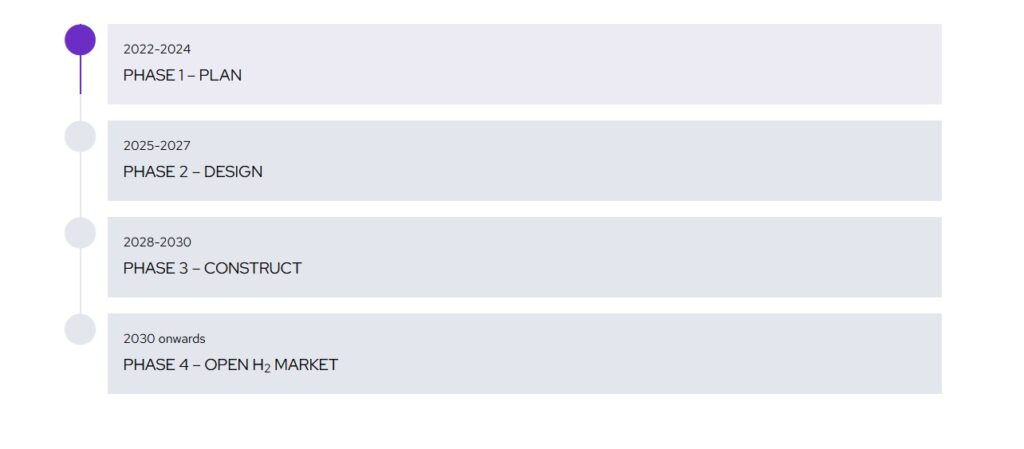
Preliminary schedule
Facts
- 1,000 km of new, dedicated hydrogen pipelines will serve 65 TWh of identified potential hydrogen demand in the Bothnian Bay region by 2050.
- The core route will be along the coastline, with a branch to Kiruna.
- The Nordic Hydrogen Route investment is estimated at 3.5B EUR, offering a hydrogen transportation cost of 0.1-0.2 €/kg.
- The pipeline would enable ten-fold investments around 37B EUR in wind power and electrolysis.
- The pipeline can facilitate emissions savings of up to 20 Mt CO2e per year by 2050. This represents around 20% of current yearly emissions in Finland and Sweden and helping the countries reach their respective climate neutrality targets of 2035 and 2045.
- The regional hydrogen economy is expected to create up to 25,000 jobs by 2030, and up to 46,000 by 2040.

- Read more:
- Invitation to Hydrogen Market Participants: Join us to develop the Finnish and Baltic Sea Region Hydrogen Market Value Chains
- Nordic Hydrogen Route Project Advances: €29.4 Million EU Funding Secured and Grant Agreement Signed 3 July 2025
- Fact sheet
- Q&A
- Press Release 22 April 2022
- Recording of the launch event 22 April 2022
- Nordic Hydrogen Route website
- Nordion Energi