
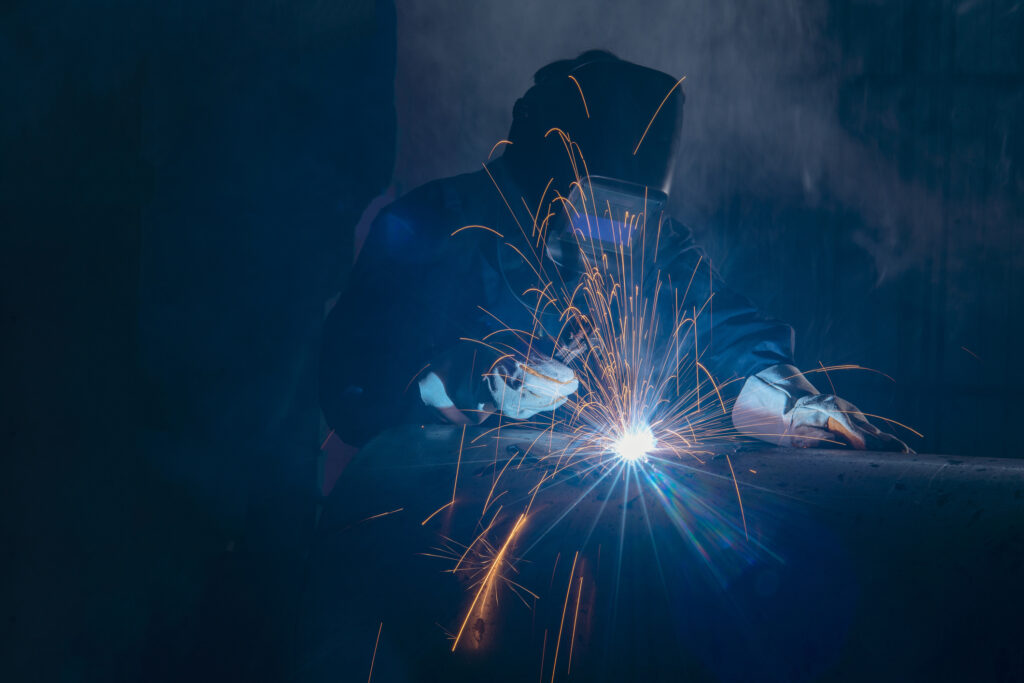
More than a thousand kilometres of hydrogen gas pipeline will provide employment opportunities for skilled welders for years to come.
Finland wants to take an ambitious leap to the hydrogen economy. The hydrogen economy could give the country a billion euro boost and create jobs for as many as 100,000 people – in addition to this, of course, hydrogen is an important part of the green transition and the shift away from fossil fuels. But what does all this mean in practice?
The Finnish Government’s decision in principle in 2023 aims for Finland to have a leading position in the hydrogen economy, producing 10% of the EU’s clean hydrogen. The Finnish Government has given Gasgrid the task of promoting the development of the national hydrogen infrastructure, international infrastructure cooperation, and the hydrogen market in the Baltic Sea region. Gasgrid is currently studying routing options for the hydrogen infrastructure and hydrogen transport needs in the Baltic Sea region.
The construction project ahead is enormous. Finland’s national hydrogen infrastructure will comprise more than 1,000 kilometres of gas pipelines – and because it’s hydrogen, the safety requirements are a couple of notches stricter than with, say, natural gas. Hydrogen is a small molecule gas known to cause hydrogen embrittlement in all materials – will carbon steel pipes be resistant to it?
We’ll manage with hydrogen
Marko Ikävalko, Head of Operations and Maintenance at Gasgrid, says that hydrogen embrittlement is not a problem as long as the impacts of the properties of hydrogen under operating conditions are understood:
“In addition to hydrogen quality, the choice of material for the hydrogen pipeline should take into account the operating pressure, and the range and magnitude of pressure fluctuation,” Ikävalko says.
How hydrogen affects materials depends on many things – in the case of steel, factors other than pressure include microstructure, grain size, alloys and ambient temperature.
Gasgrid has yet to decide the most appropriate steel grade for the hydrogen transmission pipeline, which will be around 1 metre in diameter.
“Before making an actual decision, we will consider all matters related to the lifecycle and safe use of the transmission pipeline,” Ikävalko says.
Zero leaks
But no matter how robust the hydrogen pipeline is, the joints and welding seams can be tricky: will they hold under all possible conditions? Since hydrogen is a familiar gas in the process industry, suitable connecting methods are available,” Ikävalko says.
“All joints used in the future pipeline will be suitable for use with hydrogen,” he adds.
Gasgrid’s policy is that an integral, welded pipeline does not leak.
“The basis is that all the joints are so well constructed that there are no leaks. Supervision during construction and inspection by non-destructive testing (NDT) will ensure that the joints hold,” Ikävalko says.
“The transmission pipeline joints will be done mostly by welding,” he adds.
Work for welders!
Once work starts on building the hydrogen infrastructure around Finland, skilled workers will be needed – and of course welders. Gasgrid has no installation and construction teams of its own and will use tendering process to secure contractors,” says Ossi Falck, Head of Project Offices at Gasgrid.
“The project will require welders to have specialist skills and to work outdoors in varying weather conditions,” Falck says, adding that because of the great need, it is likely that professional welders will need to also be sought outside of Finland.
“Welders must meet the qualification requirements for the project, as must installation and construction companies, he says.
The actual installation and construction process will follow the method of laying natural gas transmission pipelines. Pipe sections of 12-18 metres in length are welded together at the construction site before being lifted into a trench dug for that purpose: work then starts on joining the pipe sections to each other by welding.
“Quality assurance of the welding seams is an important part of the process,” Falck says.
—
Brief lesson on the hydrogen economy
– the hydrogen economy will have an employment impact of as many as 100,000 jobs
– the hydrogen economy will improve Finland’s energy independence and security of supply
– Gasgrid has been mandated by the Finnish Government to develop the national hydrogen infrastructure, to engage in cross-border infrastructure cooperation and to support the development of the hydrogen market in the Baltic Sea region
– Finland’s national hydrogen infrastructure will comprise around 1,000 kilometres of onshore gas pipeline. In addition, international offshore pipeline connections will be built for hydrogen transmission
– Gasgrid aims for the hydrogen market and infrastructure to be up and running in Finland in the first half of the 2030s
– the plan is to initiate hydrogen infrastructure licence procedures this year
– Gasgrid is currently working with international partners to promote three cross-border hydrogen infrastructure projects in the Baltic Sea region: the Nordic-Baltic Hydrogen Corridor, Baltic Sea Hydrogen Collector and the Nordic Hydrogen Route
Read more:
Environmental impact assessment is an important anchor in hydrogen infrastructure design