
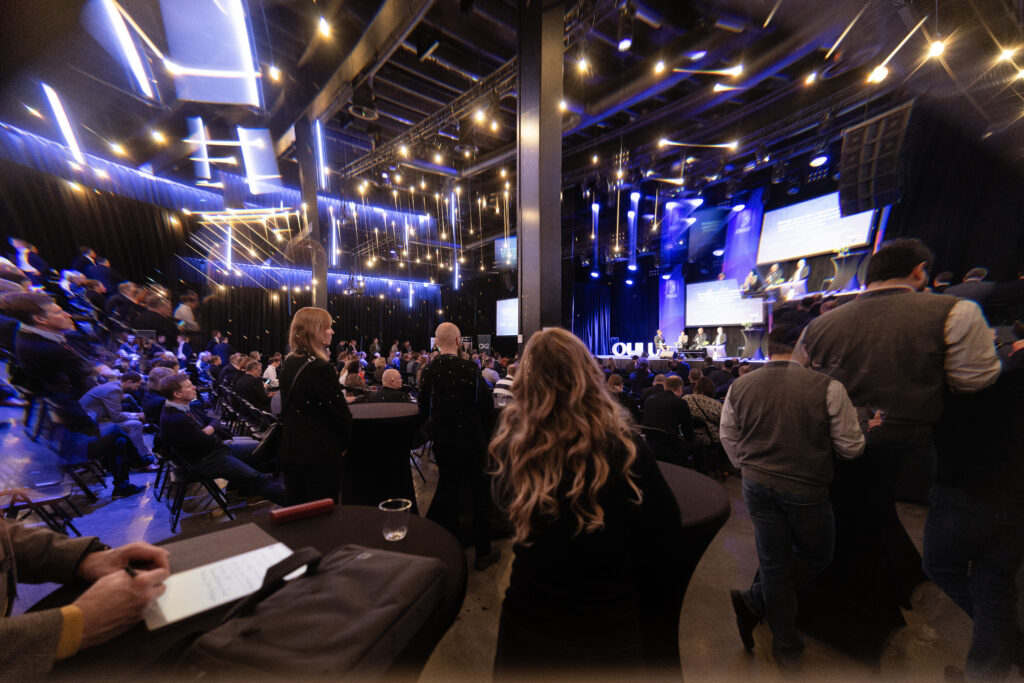
In February, the Nordic Hydrogen Week attracted dozens of international speakers and hundreds of hydrogen industry actors and other interested parties to Oulu. Topical speeches and crowning news at the event made many cheer: the hydrogen economy is becoming a reality.
As the Northern Power Business Forum, the main event of the Hydrogen Week and held on the last day, kicked off, a happy buzz of chatter could be heard in the Tullisali event centre in Oulu. More than 400 participants were present, not only from the Nordic countries, but also from elsewhere in Europe.
The atmosphere was an enthusiastic one. During the two days, good speeches had been heard and productive discussions had been held. Fittingly, the previous day coincided with news of the start-up of PX2 Solutions’ hydrogen plant in Harjavalta.
Local news was the highlight on the last day. The City of Oulu and the French company Verso Energy have signed a cooperation agreement with the aim of building Finland’s largest hydrogen plant in Oulu.
“There is now everything to look forward to,” summed up a couple of listeners in the audience.
Meetups and the latest information
Hydrogen research, the social acceptance of renewable energy projects, Nordic cooperation and hydrogen projects were the main topics of the Hydrogen Week in Oulu.
Janne Hietaniemi, Key Account Director at BusinessOulu, which was the lead organiser of the event, says the Hydrogen Week has provided the international audience with a lot of good meetups and relevant information.
Finland, Sweden and Norway face similar challenges related to the acceptability of hydrogen projects. These often involve energy production and electricity distribution needs, as well as land use.
In Oulu, Nordic actors shared their best practices and learnings. The discussions emphasised the importance of interaction and cooperation at both the local and national levels. Cooperation between the countries was considered important in order to ensure security of supply.
Room for both: hydrogen and willow tits
The opportunities brought about by the hydrogen economy in the northern region had already been examined during the week, with numerous speeches and lively discussions.
Elina Mäki, RDI Project Manager at Gasgrid, was at the round table in the hydrogen impact forum. Discussion themes were sustainable infrastructure construction, justness and local impacts.
The inspiring discussion continued as an audience event. There was a lively exchange of words about the climate benefits and the harm to biodiversity resulting from construction.
The justness discussion also talked about fauna, such as the now-endangered willow tit. The conclusion was that the potential of hydrogen can be harnessed to double the population of willow tits, if that is what is wanted.
Another conclusion was that a shared knowledge base facilitates stakeholder interaction and cooperation.
Knowledge needed at an early stage
Perhaps the most important discussion of the Hydrogen Week was about the social acceptance of hydrogen projects and getting municipal residents involved in projects at an early stage.
“I talked to many people about the topic. The need for information emerged. People must have up-to-date and correct information about hydrogen projects so that no one falls behind. When people have enough information, they also have the right basis for making decisions. Hydrogen projects need social acceptance. This avoids ending up in long cycles of appeals,” says Elina Mäki at Gasgrid.
Mäki also raised the key role that municipalities have in taking hydrogen projects forward.
“Municipalities can bring different actors together and ensure information is shared. Municipalities are responsible for statutory land use planning, which involves both the approval of projects and the siting of hydrogen plants.”
Gasgrid is doing its part to promote hydrogen products and share information.
“Our role is to share information, especially from a research perspective. We are cooperating extensively with companies and municipalities in order for timely factual information to advance hydrogen development at the national level. For example, we have published route plans for the hydrogen infrastructure in which municipal decision-makers have been involved,” Mäki explains.
The hydrogen infrastructure EIA process will get underway in the spring. In this context, Gasgrid Finland will be conducting a lot of consultations in the areas to give landowners, for example, an opportunity to comment on the plans..
Broader discussion yet to come
Minna Näsman, an expert in challenging projects and situations, was one of the top experts at the Hydrogen Week. She is involved in the sustainable development JusthH2Transit project, which examines how to make the hydrogen transition just in terms of both climate and other sustainability aspects.
Like Mäki, Näsman emphasises the importance of social acceptance.
“The hydrogen transition will not go anywhere at all if its local phenomena, i.e. projects, are not accepted,” she says.
Project researchers have mapped hydrogen-related editorial material published by three major newspapers as well as the hydrogen discussion.
“The hydrogen discussion is positive. We were struck by how conspicuous the questions were by their absence.
During the Hydrogen Week in Oulu, Professor Eva Pongratz from the University of Oulu gave a presentation on the topic. If the hydrogen transition proceeds without discussion, the transition may get stuck in resistance simply because people have been unable to ask and hear answers that satisfy them. That’s when people feel like protesting.
Minna Näsman’s interpretation is that the hydrogen transition has been promoted by hydrogen advocates, but that a broader discussion has not yet got underway.
Reliable knowledge base for discussion
The Hydrogen Impact Forum concept, developed by the Just Transition project, has been implemented once in Pori, and now in Oulu. It brings together the different perspectives necessary for the implementation of hydrogen projects. All events will be attended by representatives of organisations that raise the perspective of nature.
“We are careful to ensure that discussion are not just limited to hydrogen investors and leading local government officials. We also need to involve people who do not yet know what the hydrogen economy means and what lies ahead, but who know a great deal about their own environment,” Minna Näsman says.
The researcher found the discussion in Oulu interesting and rewarding, because there was a broad crowd of listeners.
“People had not yet become entrenched, but were able to discuss different perspectives. There were also people present who were immediately able to correct misconceptions and provide corroborating background information.”
Minna Näsman hopes that the multi-perspective discussion will continue as this creates resources to solve problems as well.
“Key players need a common negotiating table. Besides which, a lot of open and participatory civil dialogue is needed based on a reliable knowledge base. If there is insufficient information, the vacuum can easily be filled with fear and disinformation. Even with hybrid operations, if things go badly.
Even sleeping bears have woken up
The outcome of the Hydrogen Week in Oulu is clear: hydrogen development will not stop there, but take new leaps forward.
The Norwegian participants sent a strong message to other participants at the Hydrogen Week. High-quality information provided at an early stage is also valuable in terms of the success of hydrogen projects and market access, i.e. financially.
Minna Näsman sums up:
“We want high-quality interaction at an early stage to be the new normal. Now we have to have the courage to wake up the sleeping bears and have a conversation with them. In the best-case scenario, the hydrogen economy will become not only acceptable, but even desirable.
—
Nordic Hydrogen Week
- Nordic Hydrogen Week took place in Oulu 11-13 February in Oulu, Finland.
- The largest international hydrogen event in Northern Finland.
- Main topics during the hydrogen week: hydrogen research, social acceptance of renewable energy projects, Nordic cooperation and Nordic hydrogen projects.
- The week’s main event: Northern Power Business Forum on 13 February, which had 35 speakers and attracted more than 400 participants from different countries.
- Hydrogen Week was organised by BusinessOulu and CleanTech Oulu, together with their partners: Oulun Energia, Gasgrid, Finpec, OX2, H2Cluster Finland, Resato Hydrogen Technology, Nordion Energy, Oulu2026 European Capital of Culture, Oulun Kärpät and Kaleva.
- More information at www.gasgrid.fi, www.businessoulu.com