
Gasgrid’s Olli Sipilä and Sara Kärki are convinced that hydrogen will bring a shot in the arm to Finnish society as a whole – but attractive growth opportunities are opening up right now particularly at the regional level.
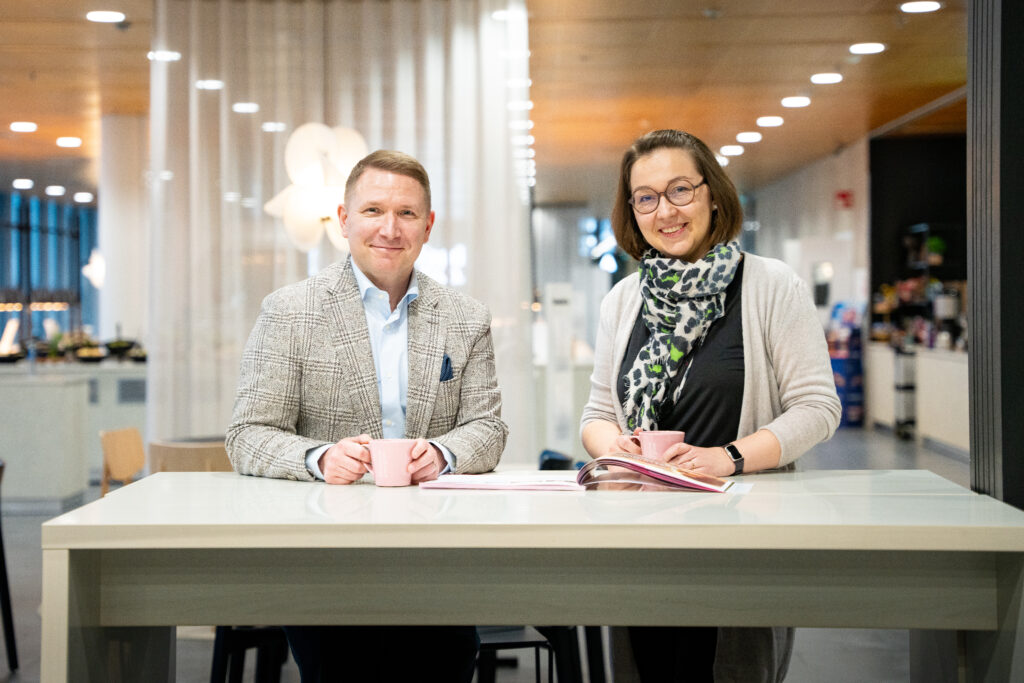
Hydrogen economy is today’s buzzword. Hydrogen flowing in underground pipes is intended to bring growth and jobs to Finland, but what is it all really about? And why is the hydrogen project needed in the first place? Gasgrid’s CEO Olli Sipilä and Senior Vice President of Hydrogen Development Sara Kärki share their insight into what people should know about hydrogen and its potential.
According to Sipilä, a major energy revolution is under way, changing all of society by increasing, among other things, our self-sufficiency. The transition from fossil fuels to emission-free fuels is a major effort that requires the participation of all possible sustainable energy producers, from solar and wind power to nuclear power and bioenergy.
“In this process, everything that can be electrified is being electrified, and electricity is being generated cleanly, without CO2 emissions,” says Sipilä.
However, we are burdened by a carbon legacy in the form of oil, natural gas and coal, and replacing them completely is a difficult task. This is where hydrogen comes in:
“Hydrogen can be produced when renewable energy, such as wind power and water, is available. It replaces everything that cannot be easily replaced by electricity,” states Sipilä.
“Finland is in an excellent position, because we have access to clean, affordable energy – in fact, we can produce more energy that we could ever use,” he adds.
Hydrogen is driving force for industry
One way to use electricity is to make clean hydrogen. But what is the hydrogen then used for? Kärki explains that hydrogen is one of the raw materials of the future, with applications in industry and transport as well as in district heating production.
“Hydrogen is a potentially transformative force similar to the emergence and evolution of the forest industry – a true crown jewel of the economy,” says Kärki.
Hydrogen is also very impressive when it comes to transmitting energy efficiently over long distances.
“If we are talking about efficiency, a 1-metre-diameter hydrogen pipe can replace as many as 15 power lines,” Sipilä points out.
Targeting the 2030s
The hydrogen infrastructure planned for Finland will measure as long as 1,000 kilometres. This infrastructure requires routing, permits and thorough planning – the entire hydrogen market is now being built essentially from scratch.
“A national hydrogen infrastructure could be in use in the first half of the 2030s,” says Sipilä.
In Gasgrid’s plans, hydrogen pipelines connect ‘hydrogen valleys’, which are the regional hydrogen infrastructure. The local hydrogen valleys will combine green hydrogen production, consumption and storage – and hydrogen will be transmitted farther to neighbouring municipalities or even neighbouring countries via the hydrogen infrastructure.
“Clean hydrogen is also an export product that other countries are interested in,” stresses Kärki.
Hydrogen concerns everyone
The construction of hydrogen infrastructure is a major national project with many stakeholders. Sipilä and Kärki agree that society’s widespread acceptance of hydrogen is extremely important.
“We work closely with regions and municipalities. For example, new industrial parks that utilise hydrogen are already being planned,” says Kärki.
Sipilä is especially pleased that the hydrogen infrastructure is being built in a decentralised way, with the regions playing a major role.
“The hydrogen infrastructure supports each region’s industrial strengths and will bring pure growth locally,” Sipilä reckons.
“Finland’s economy has not grown in 17 years, and hydrogen could be a shot in the arm for it,” adds Kärki.
A marathon, not a sprint
Sipilä and Kärki readily admit that these are early days – no one knows for sure how and over how long a period the hydrogen market will develop. The Finnish Government has, however, resolved that Finland’s goal is to become the European leader in the hydrogen economy, and Gasgrid’s task is to build a national hydrogen infrastructure as the backbone of that effort.
“We don’t have the answers to all the questions, but we are learning all the time. Right now we are laying the foundations that will guide the development of the hydrogen infrastructure for decades to come,” states Sipilä.
Gasgrid is proudly and confidently carrying out the Government’s mandate.
“There has been no unplanned downtime in the current natural gas pipeline during Gasgrid’s era,” says Sipilä.
Of course, that era is not very long, given that the transmission network company Gasgrid Finland Oy only started its operations on 1 January 2020. The last unplanned shutdown of Gasgrid’s predecessor, Gasum, occurred in 2016.
“Our goal is the same for the hydrogen pipeline – there are no surprises in store. We will still transmit gas reliably and safely,” Sipilä promises.
—
WHO:
Name: Olli Sipilä
Job title: CEO, Gasgrid.
Education: M.Sc., Economics & Business Administration, Industrial Management (2003)
Best part of the job: It is meaningful and relevant.
Motto: You should always give 100%, even in the face of major challenges. There is a solution to any problem.
Hobbies: Fly fishing, cycling, swimming, cooking and lately, golf.
WHO:
Name: Sara Kärki
Job title: Senior Vice President, Hydrogen Development, Gasgrid.
Education: MSc Power Plant Technology, Energy and Industrial Economics, Chemistry (2010).
Best part of the job: The work is meaningful, challenging and involves collaborating with many stakeholders.
Motto: Hobbies: walking, spending time with friends and family, travelling.
—
GASGRID
- Gasgrid is Finland’s network operator responsible for gas transmission and the transmission system, and the builder of the national hydrogen infrastructure.
- The Group consists of the state-owned parent company Gasgrid Finland, and the subsidiaries Gasgrid vetyverkot and Floating LNG Terminal Finland.
- Provides Finland’s industry and companies with the safe, reliable and cost-effective transmission of gases, and ensures security of supply and energy independence.
- The goal is for a large proportion of Finland’s industrial customers to be connected to the network in the early 2030s.
- The high-pressure gas hydrogen infrastructure is located in southern Finland.
- The network already transmits natural gas, Finnish biogas and liquefied natural gas (LNG).
- New synthetic methane production plants will be connected to the infrastructure in the coming years, which will increase the share of renewable gases.
- Gasgrid’s team of specialists already includes over 100 gas industry experts.
- Offices in Espoo, Kouvola, Imatra, Mäntsälä and Inkoo.
Read More:
Gasgrid – Enabler of future energy solutions – Gasgrid Finland