
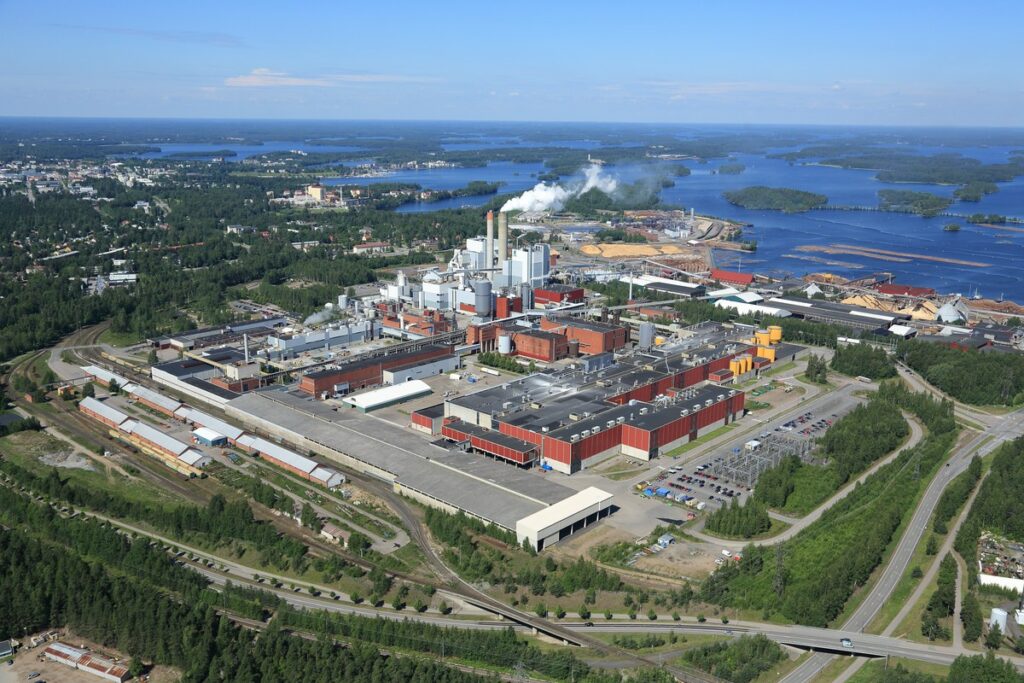
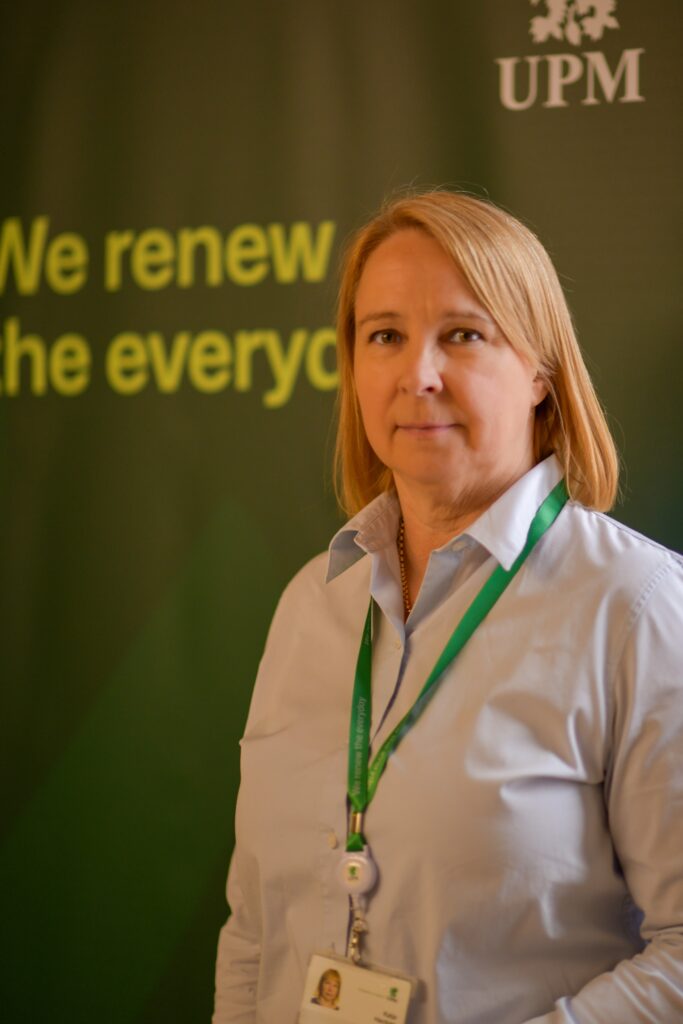
Gas has traditionally held a big role in the forest industry – and UPM is far from an exception. Katja Havikari, Director, Energy, Pulp Operations Finland, says that in fact, UPM is one of the biggest users of gases in Finland.
“We’re probably the second or third biggest consumer of gases in Finland,” Havikari says.
Within the UPM Group, pulp operations are the biggest user of gases.
Gas is also used in the production of UPM’s specialty papers and printing papers, label materials and biofuels. The largest users of UPM’s mills are Kaukas, Kymi and Tervasaari. The former uses gases in the most versatile way in its operations,” Havikari considers.
The largest single consumer of gas in pulp mills is the lime kiln, where lime sludge calcium generated in the recovery of process chemicals is burned into lime so that it can be reused in the pulp process.
“There are many other uses for natural gas on our paper and pulp mills and biorefinery. In mills, gas is used, for example, in drying and energy production – and as an auxiliary fuel in disruptions and shutdowns.”
UPM is interested in expanding its gas portfolio
When talking about the use of gas at UPM, we are mainly talking about LNG. Biogas offers a lower-emission alternative, and synthetic gases and hydrogen are seen as opportunities for the future. However, UPM is interested in expanding its gas portfolio as part of its commitment to sustainability and combating climate change.
“For example, biogas and its development and certifications on the market create confidence, and we are monitoring the situation closely.”
The hydrogen economy is still a vision for the future, and UPM is following its development with interest. The company has its own production of low-emission electricity, bio-based carbon dioxide, and experience in the production and use of hydrogen in refinery processes.
“Biogases, in particular, offer us the opportunity to reduce emissions in the near future, which is well in line with the company’s strategy. Rather, hydrogen issues are a vision for the next decade,” Havikari considers.
“Each business area assesses the need to introduce new gases, based on its own starting points,” Havikari says.
According to Havikari, it is easy for a large industrial operator to rely on gas in Finland: the gas infrastructure is first class and there are hardly any problems in everyday life.
“Security of supply is the added value that the national gas infrastructure creates.”
Cool-headed partner proved its worth
Havikari commends the fact that Gasgrid Finland has also demonstrated its ability to act quickly and decisively in crisis situations. When natural gas deliveries from Russia ended in 2022, Gasgrid built an LNG terminal in Inkoo in record time.
The floating LNG terminal started operating in the port area of Inkoo in January 2023. When LNG ships arrived at the terminal – about 1–3 per month – the crisis mood began to recede.
“Whenever challenging situations have arisen, they have been handled very well at Gasgrid,” Havikari says.
Gas market foundations were carefully laid
The effective cooperation between UPM and Gasgrid Finland was already visible in the launch of the gas network company. For example, UPM was involved in workshops that began in 2018 in preparation for the start of Gasgrid in 2020. Havikari considers the robust workshops to be a good example of how first Gasum and then the gas transmission network company Gasgrid Finland, which was unbundled from Gasum following the opening-up of the gas market, have always listened to the wishes of market operators.
“Since then, these wishes have largely been fulfilled in the creation of a gas portal and infrastructure development,” Havikari adds. She says that it has been great to see that Gasgrid Finland has taken into account the wishes of both large and small gas users as far as possible.
Sustainable development and predictability guide the use of gases
Havikari has worked at UPM for a long time and has had a ringside view of the many changes in the industry. The position of gases in mills has not been undermined during that period, but the green transition will certainly affect which gases are planned to be used.
“Sustainable development is also driving the change in the gas sector. If implemented, cleaner gases from mills will, of course, also strengthen the competitive position of Finnish industry.”
However, the business needs stability and predictability, which is why Havikari hopes for two things in particular: that the security of supply in the gas infrastructure remains at a good level and that gas prices remain moderate.
“We are a market-based operator and naturally also monitor the gas situation in all ways.”
—
UPM in brief
– a material solutions company that offers renewable and sustainable solutions
– the company’s diverse portfolio includes renewable fibres, advanced materials, carbon dioxide emission reduction solutions and printing papers
– seven business areas: UPM Fibres, UPM Energy, UPM Raflatac, UPM Specialty Papers, UPM Communication Papers, UPM Biorefining and UPM Plywood
– signed the UN 1.5°C climate pledge; listed as the only forest and paper industry company in the Dow Jones Global and European Indices (DJSI) for 2024–2025
– One of the largest gas users in Finland; pulp operations use the most gas
– 15,800 employees
– sales appr. €10.3 billion
– shares listed on Nasdaq Helsinki Oy
Read more:
Gases are irreplaceable as raw materials and fuels in industry – Gasgrid
What on earth is a multi-gas platform – and why is it revolutionising Finnish society? – Gasgrid