
Cold winter weather has caused a sharp rise in gas demand, according to Gasgrid, which is responsible for gas transmission in Finland. As a result, gas consumption volumes in January 2026 were at their highest levels since December 2021. Gas plays an important role in energy production during cold weather: without gas-fired, decentralized electricity production, electricity prices would have been higher than they actually were.
In January 2026, daily gas consumption in Finland averaged 70–80 gigawatt-hours, and on several days, the 100 gigawatt-hour mark was exceeded. 100 gigawatt hours of energy corresponds to the annual heating energy of approximately 10,000 district-heated apartment buildings.
In January 2026, a total of approximately 2.5 terawatt-hours (2,500 GWh) of gas was used, with the highest daily consumption reaching approximately 120 gigawatt-hours. Gasgrid’s highest monthly gas consumption in its history was in January 2021, when 3.8 terawatt hours of gas were consumed.
Most of the gas in Finland is used for industrial and energy production purposes. In January, gas was used most in the energy production segment, where cold and low-wind weather created demand for gas.
–Gas has played an important role in the electricity market during the cold weather at the beginning of the year. Without gas-based, adjustable, and weather-independent electricity production, electricity prices would have been higher than they actually were. This shows that the gas transmission infrastructure is of great social importance, says Mika Myötyri, who is responsible for gas markets and customers at Gasgrid.
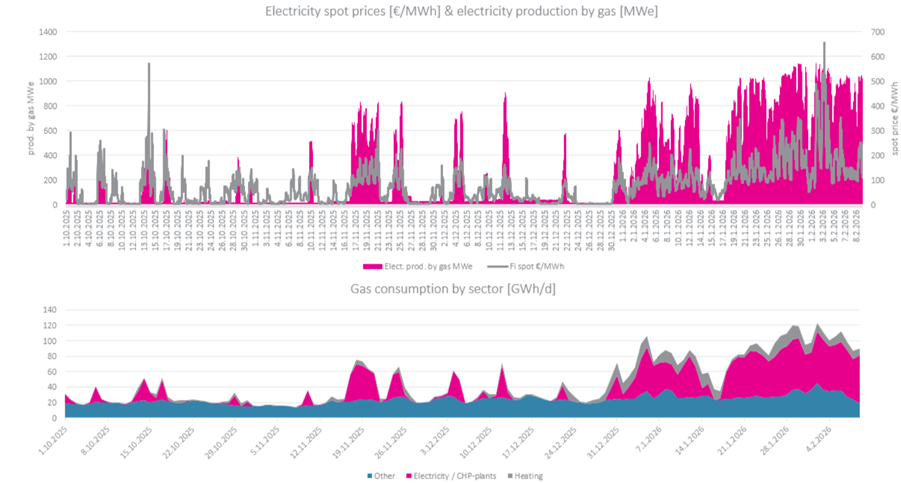
In January, industry used approximately 20 gigawatt hours of gas per day. In addition to oil refining, the forest, paper, steel, and chemical industries are the largest consumers of gas in industry.
Most of the demand for gas in January was met through Balticconnector
According to Myötyri, most of Finland’s demand for gas in January was met by gas imported from the Baltic region through the Balticconnector undersea pipeline between Finland and Estonia, and the pipeline’s capacity was fully utilized. The rest of Finland’s gas demand was covered by the LNG terminals in Inkoo and Hamina, which feed liquefied gas into the network.
–The Inkoo LNG terminal has been a key import route for ensuring gas imports that meet market demand and Finland’s security of supply and maintenance, he says.
Gasgrid’s Finnish gas transmission network connects two LNG terminals and five biogas plants and is linked to the Balticconnector offshore pipeline, which enables gas transmission between Finland and Estonia.
Further information
Media inquiries: Gasgrid Communications, viestinta@gasgrid.fi
Customer inquiries: customerservice@gasgrid.fi