

Gasgrid will organize nine discussion events in autumn across Finland, where companies will have the opportunity to express their views on the routing of the hydrogen transmission backbone in Finland, the need for hydrogen transmission, and their interest in joining the hydrogen network in their area. Get involved early!
Up to €110 billion and 100 000-200 000 new jobs. The investments brought by the hydrogen economy can be a much-needed engine of economic growth in Finland in the coming decades.

Heli Virkki, Head of Hydrogen Valley Development at Gasgrid, lists several reasons why Finland could become Europe’s leading hydrogen economy:
- Finland has a competitive price for renewable electricity production in Europe
- Finland has plenty of space to build new wind power onshore, unlike in Germany, for example, where the only option to build new wind power is offshore
- Our electricity grid is extensive and technically well-functioning
- Reliability of electricity supply is among the best in the world
- Finland’s forest industry produces bio-based carbon dioxide, which, in addition to renewable hydrogen, is an important raw material for the hydrogen economy
- Finland has lots of fresh water, from which green hydrogen is produced by electrolysis using renewable electricity.
The next step is to identify the regional connection needs to the hydrogen pipeline and the need for transmission capacity
Gasgrid is building a national hydrogen network in Finland. The route options for the hydrogen backbone were announced in April this year. The most technically and economically feasible route for the trunk pipeline is currently being sought in the north-south direction. The provinces and municipalities have already submitted their land-use comments on the route, and now it is the turn of companies and developers.
“In autumn, we will organize a discussion event in nine localities for companies to give feedback on the route options for the pipeline and express their interest in regional connectivity,” says Virkki, who welcomes all companies with activities related to the hydrogen economy to participate.
“We probably don’t even know all the companies linked to the hydrogen economy yet. There may also be companies that do not directly produce or use renewable hydrogen. For example, district heating companies or greenhouse entrepreneurs may use surplus heat generated as a by-product in electrolytic hydrogen production.”
Gasgrid is asking companies to do two things at the discussion events.
“The core is location information, i.e. from which locations future hydrogen producers and users would come to connect to the hydrogen transmission pipeline. Gasgrid will also provide a techno-economic pre-planning service to identify connection possibilities. Transmission capacity is also of interest: how much hydrogen a future hydrogen producer or consumer intends to transport. This information will help our technical design when considering the sizing of the pipeline.”
For project developers and companies, there is also a market survey on Gasgrid’s website where this information can be provided in confidence.
Companies are asking Gasgrid a lot of questions about the hydrogen network, and rightly so.
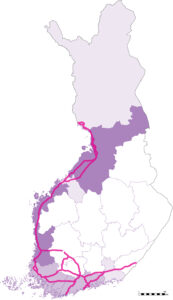
“A lot of questions have been asked about the safety distances and alignment principles of the hydrogen pipeline, i.e. where the trunk pipe can be laid. There are also safety issues. These are very important issues for us to consider in hydrogen infrastructure projects,” says Virkki.
Companies are also interested in how the hydrogen market will work in the future: for example, how the marketplace will be built, how to connect to the infrastructure, how capacity reservations will be made, and how pricing will be set.
Companies should be active in the discussions and ask questions, even if, according to Virkki, not all questions may yet be answered.
“For example, there is still no legislation on hydrogen transmission, so the natural gas regulation and the hydrogen guidelines published by Tukes at the beginning of the year are used as a basis for planning.”
Planning for the connection of regional hydrogen valleys will start once the trunk pipeline has been routed
Once the route of the hydrogen trunk pipeline has been decided, the design of regional hydrogen pipeline grid will start from around 2025. These are smaller diameter, low-pressure grids, hydrogen valleys, which join the trunk pipeline as regional branches.
Heli Virkki describes a hydrogen valley as an industrial-scale hydrogen hub, where the entire hydrogen value chain can be found:
- Renewable electricity production
- Hydrogen production
- Hydrogen storage
- Hydrogen transmission
- Final use of hydrogen
Hydrogen economy also provides large employment at the regional level
The hydrogen economy brings new opportunities and jobs to municipalities. Initially, the focus will be on jobs related to the design and construction of new industrial plants. Regions will need specialists in areas such as permitting, engineering, land use planning, and zoning. The construction of hydroelectric plants and infrastructure will also require a large regional workforce.
“In the operational phase, the operation of hydrogen plants and the running of the business also require specific skills and create new jobs in municipalities. Managing the regulation of the hydrogen economy coming from the EU also requires new skills.”
Educational institutions have already started to design training programmes for the hydrogen economy.
“For example, Tampere University of Technology has launched a graduate engineering degree programme in energy disruption. The interdisciplinary subject combines electrical, energy and information technology, environmental sciences, chemistry and social sciences, among others. Its aim is to train people for the green transition, not just for the hydrogen economy,” says Virkki.
Investment decisions already amounting to €150 million
Currently, €150 million in investment decisions have been taken in Finland’s hydrogen economy, and many more are planned.
For example, P2X Solutions’ hydrogen plant will start operations in Harjavalta this autumn. It will start producing green hydrogen for industrial use. It will also process hydrogen into renewable synthetic methane and methanol using captured carbon dioxide. These can be used as fuel for road and marine transport.
Helen is also building a pilot hydrogen plant in Vuosaari in Helsinki and Fortum in Loviisa, both of which will use electrolysis to produce hydrogen.
Text by Jouko Vuorela
Images by Gasgrid and GettyImages