
Finland is currently exploring routing options for national hydrogen infrastructure and the need for hydrogen transmission capacity. A hydrogen economy built on hydrogen infrastructure can have a national economic impact of around EUR 30 billion and create jobs for 100,000 people. The hydrogen economy will bring new investments and jobs to municipalities, as well as improve Finland’s energy independence and security of supply. Once completed, the national hydrogen grid will thus have a significant impact on municipal finances and regional well-being.
The text ties in with the Kuntamarkkinat municipal fair which was held September 18–19, 2024, in Helsinki, where Gasgrid took part in the discussion on national hydrogen grid routing and the opportunities the hydrogen economy will bring to municipalities. The blog was published in Finnish on the Kuntamarkkinat website.
Gasgrid has been mandated by the State of Finland to develop a national hydrogen grid and engage in cross-border infrastructure collaboration.

Planning and building hydrogen infrastructure is a massive undertaking! The first spade will strike ground where we find the greatest demand for and interest in the hydrogen industry. Our goal is for the hydrogen market and infrastructure to be operational in Finland in the early 2030s. The pipeline would transmit green hydrogen, i.e. hydrogen produced mainly with renewable electricity. Green hydrogen is needed as a raw material for industry to replace fossil energy sources.
The development efforts need the involvement of municipalities, decision-makers, and companies even before the permit processes begin
The intention is to initiate the permit processes for the hydrogen grid in 2025. The environmental impacts of the national hydrogen grid will be assessed in regional Environmental Impact Assessments (EIA), which will involve extensive studies on, among other things, the current state of the planned pipeline routes. The impacts on, for example, nature, the landscape, people and land use will also be assessed.
Public events will be held in connection with the EIAs, and we will collect feedback on the route options from stakeholders. Thereafter, the projects will advance to a more detailed planning phase and the subsequent permit phases, which will draw on the collected data and feedback.
The national hydrogen grid will comprise over 1,000 kilometres of onshore gas pipeline, in addition to which international offshore pipeline connections will be built. The onshore gas pipeline will be laid underground at a depth of roughly one and a half metres. The right-of-way needed for the pipeline is around five to ten metres wide, and, for instance, farming can continue after construction as before.
Various stakeholders now have, even before the actual EIAs and permit procedures begin, an excellent opportunity to influence the planning of the national hydrogen grid, as they can contact us during the currently ongoing route planning.
The hydrogen grid and economy can only be achieved through smooth co-operation, and the work will be carried out for the common good.
Gasgrid is building hydrogen infrastructure and a platform for a hydrogen market in Finland.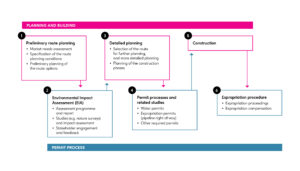
Kirsi Koivunen
Head of Permitting, Gasgrid
kirsi.koivunen(at)gasgrid.fi
Heli Virkki
Head of Hydrogen Valley Development and Customer Project Development, Gasgrid
heli.virkki(at)gasgrid.fi
Gasgrid is the transmission system operator responsible for gas transmission, the transmission system in Finland, and the builder of the national hydrogen infrastructure. We offer our customers safe, reliable, and cost-effective gas transmission and connection service. We actively develop our transmission platform, services, and the gas market in a customer-oriented manner to promote the carbon-neutral energy and raw material system of the future. Gasgrid Group consists of the state-owned parent company Gasgrid Finland Oy, and the subsidiaries Gasgrid vetyverkot Oy and Floating LNG Terminal Finland Oy. Read more: gasgrid.fi/en