
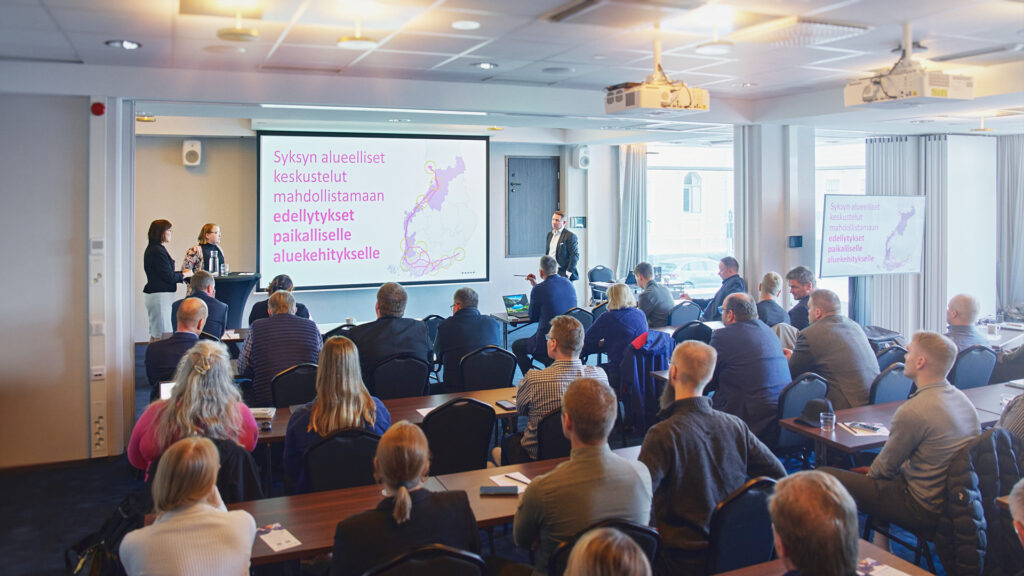
At a regional event organised by Gasgrid for businesses on the local development of the hydrogen infrastructure in Oulu on 11 October 2024, the atmosphere was high as around 50 actors gathered to listen and discuss the national hydrogen infrastucture. The event is one of nine regional debates organised by Gasgrid this autumn.

In Oulu, there was even a little competition between different regions for a place at the forefront of the green transition and the use of the hydrogen gas pipeline. In North Ostrobothnia, many things were found to have happened and to be happening to promote the green transition.
-We have many things going on, sums up Janne Hietaniemi, Account Manager at Business Oulu.
-Oulu has the research, technical know-how, and companies in the sector whose expertise can be used to develop hydrogen technology. An industrial-scale hydrogen plant is planned for Oulu and the city is planning large areas for green industry.
Managing Director Toni Krankkala from NIHAK, the development company of the Nivala-Haapajärvi region, continued to list the strengths from the perspective of the southern part of the Oulu province.
-The main electricity grid crosses the area, and has a significant amount of wind power and good transport links for the distribution of hydrogen, if not all the hydrogen is piped. There are also biorefineries on the way.
The perspective of a large industry committed to the green transition was brought forward by Harri Leppänen, a director of SSAB. SSAB’s Raahe plant is converting its iron production to fossil-free and needs hydrogen.
-The hydrogen pipeline network is very welcome. It is hoped that the pipeline will run close to the coast.
Esa Pellikainen, Executive Vice President of the Oulu Chamber of Commerce, believes that Gasgrid’s hydrogen gas pipeline will fit well into the investment decisions of the whole region.
-I am excited about the shared enthusiasm. But I hope that we can avoid unnecessary disputes between regions.
North Ostrobothnia in a good position in the hydrogen economy
The hydrogen pipeline will contribute to the green transition cost-effectively, said Olli Sipilä, CEO of Gasgrid.
-The ambitions are huge. Where they can be delivered competitively, we are well placed.
North Ostrobothnia is one such area.
– Clean electricity is everywhere here. Hydrogen production enables the exploitation of large-scale electricity potential. Northern Finland and northern Sweden are particularly good locations for electricity-based industry.
-40% of renewable energy production already comes from the North. It is entirely possible to attract billions of euros of investment here.
Hydrogen gas moves efficiently in the pipe
Participants at the Oulu Business Event listened with interest to Gasgrid’s practical plans for a national hydrogen transmission route.
The aim is to build a pipeline over 1,000 kilometers long in Finland.
-Hydrogen allows energy to be transferred efficiently over long distances. A one-meter diameter hydrogen pipe can replace up to 15 power lines, said Olli Sipilä.
The underground hydrogen pipeline would run from southern Finland along the coast to Haparanda. The pipeline would need a 5 to 10-metre-wide strip of land.
-The hydrogen pipeline will mainly enter arable land, avoiding groundwater and recreational areas. Arable land is preferred because farming can continue normally in arable land even after the pipeline is built, said Gasgrid project developer Henriikka Pilpola.
North Ostrobothnia now has 2-3 options for the hydrogen transmission infrastructure, one of which will be implemented. Discussion with companies and other stakeholders will guide the planning process.
Ambitious targets for the Hydrogen Forum
Once the hydrogen gas pipeline alignment is decided, the planning of the regional hydrogen pipeline network begins.
The hydrogen pipeline “highway” and its branches will benefit municipalities and businesses through increased vitality, jobs, and tax revenues. The construction of the hydrogen pipeline requires planning, expert services, earthworks, and logistics, Gasgrid CEO Sipilä said.
The hydrogen pipeline has an ambitious timetable. Hydrogen gas would be flowing through the pipelines as early as the 2030s when ambitious emission reduction targets will enter into force in Europe. Finland is aiming for a leading role in the European hydrogen economy and the national hydrogen pipeline is part of this.
The cost of building the infrastructure needed to transport the hydrogen is estimated at €5 billion, while the hydrogen storage facilities would cost between €2 billion and €5 billion.

Developing a market model for hydrogen transmission
Gasgrid’s national hydrogen network will be designed in partnership with regions and industry. Options for the pipeline route are now out for consultation.
-They will specify with the operators where the trunk line should run. Once the route alignment has been decided, the design of the pipes that will be installed as regional branches of the trunk pipeline will begin explains project developer Henriikka Pilpola.
In the coming years, a market model for hydrogen transport will be developed in parallel with the pipeline design. The aim is to engage companies, especially large industries, in the project so that an investment decision could be taken in 2026, by which time the pipeline should have all the permits and necessary alignments in place.
Summing up the debate, Olli Sipilä highlighted the importance of cooperation and social acceptance.
-You must feel that you are genuinely benefiting from the change. Regional and Nordic cooperation must work within and between different levels. We must also remember security, which is both technical and geopolitical security in the project.
-Then we have every chance of becoming a top player in the green transition at the European level.
Read more
Hydrogen Valley is a regional anchor for the hydrogen economy – Gasgrid Finland