
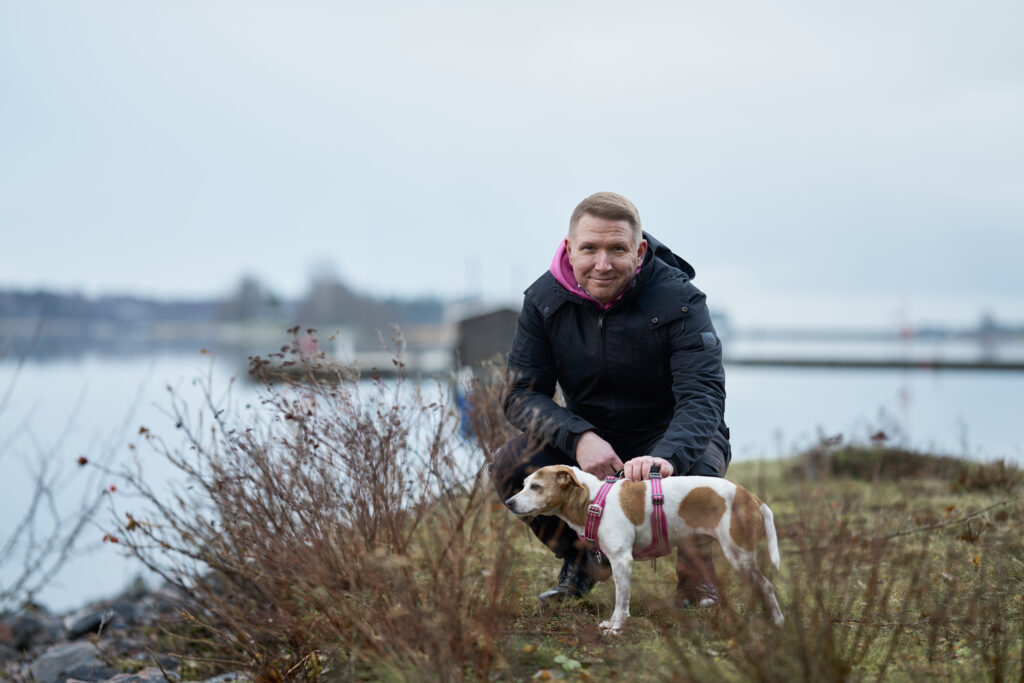
The great energy revolution is challenging all actors in the sector. One of the agents of change is Gasgrid, which is responsible for building the national hydrogen infrastructure to accelerate clean economic growth. According to a government decision in principle, Finland aims for a leading position in the hydrogen economy in Europe. At the same time, the benefits of other clean gases have begun to be increasingly apparent.
Gasgrid’s CEO Olli Sipilä notes that when fossil fuels are replaced large scale, a new kind of “interconnecting infrastructure” will be needed.
“There are always ups and downs and uncertainties in transition, but the direction is clear,” he says. “We Finns have permission to try and permission to succeed when the baselines are good.”
Hydrogen is hard to beat when energy needs to be transported effectively over long distances.
“A 1-metre diameter hydrogen pipe can replace as many as 15 large power lines,” is the comparison Sipilä makes.
No time – yet zero emissions are a way off
Back in the day, transitions to coal and oil took place over several decades – whereas the current transition to zero emissions needs to take place about three times faster than previous energy transitions. To reach climate targets, zero-emission hydrogen is needed in Finland and in Europe in those places where electricity is not the solution.
“It is against this backdrop that Gasgrid is responsible for developing the national hydrogen infrastructure, international infrastructure cooperation and the hydrogen market in Finland and the surrounding area. The objective is to create good and predictable investment conditions in Finland for hydrogen production and for the downstream industry using it. A key role in all this is to create a genuine multi-gas platform,” Sipilä says.
“The multi-gas platform will draw on all the expertise that our organisation has accumulated in gases over a very long time,” says Sipilä, who has served as Gasgrid’s CEO since the company was established in 2020.
Excellence in the gas industry is a strength
The multi-gas platform means that in the future, some of Gasgrid’s pipelines will transport hydrogen and perhaps even carbon dioxide in addition to conventional natural gas, biogas, synthetic methane and LNG. These gases contrast greatly with natural gas, for example, since they are low- or zero-emission gases.
“We are already world-class in terms of reliability and safety with regard to methane. The hydrogen side on the other hand is based on our solid gas expertise, which we are now extending to hydrogen.”
New solutions are currently being explored for biogases and synthetic methane, for example, to get the gas to flow in the pipeline. “One possibility for market participants is the use of tanks. Plans are already underway with customers to enable this,” Sipilä says.
Carbon dioxide can also be captured from factory smoke stacks and transported through pipes for downstream processing.
“Carbon capture can be used to produce, for example, synthetic methanol,” Sipilä says.
Three aspects of the hydrogen revolution
The priority on the CEO’s desk is overall development of the energy system to deliver economic growth, security and other strategic benefits for Finland through gases. Gasgrid will continue to develop the methane system, for example to benefit industry and the electricity system. The latest fastest developing area is the promotion of the hydrogen infrastructure and market through substantial measures. According to Sipilä, this requires focusing on three things simultaneously to maximise the benefits for Finland.
“Firstly, for the Finnish hydrogen backbone, we need routing, licensing and thorough planning. North-south energy transmission needs are growing rapidly and greatly. The hydrogen infrastructure could be one of the keys to this solution. We need to find out how much hydrogen can be produced and how much is needed,” he explains.
The second goal involves the creation of hydrogen valleys. A hydrogen valley is a regional hydrogen infrastructure that combines green hydrogen production, consumption and storage with the transport infrastructure. In the first phase of the hydrogen revolution, there could be several such domestic hydrogen valleys across Finland.
“We need to identify and participate in building these key valleys to attract high manufacturing and technology development to Finland,” Sipilä says.
The third goal concerns international cooperation: hydrogen should be able to flow across national and continental borders. This may have a major impact both on attracting investment in hydrogen production and downstream processing in Finland and on the utilisation of subsidies. This will speed up bringing more jobs and economic growth to Finland.
Playing an open hand for the best outcome
“Much still needs to happen over the next couple of years for the hydrogen network to remain on schedule. The final window for investment decisions is 2026-28 at the earliest,” Sipilä notes.
“This means the hydrogen infrastructure could be in use in the earlier 2030s.”
“Building the hydrogen infrastructure is a national major project involving many stakeholders. Broad social acceptance of hydrogen and clean growth is “of utmost importance”,” Sipilä considers.
“Open dialogue is highlighted when meeting stakeholders. While we have no ready answers to all questions, there is strong determination to find the best solutions,” he says.
“The principles are now being created to guide development of the hydrogen infrastructure for decades to come.”
—
WHO?
Name:
Olli Sipilä
Job:
CEO, Gasgrid Finland Oy
Education:
Master of Science in Economics & Business Administration, Industrial Management, 2003
Best thing about the job:
Meaningfulness
Motto:
It’s enough to always try your best, even when the challenge is big. When working together, a good enough solution is usually always found in the end.
Hobbies:
Fly fishing, cycling, swimming, cooking, and the most recent hobby – golf
—
Gasgrid’s strategy 2024–2026 – aiming for a flexible, low-emission energy system
Gasgrid’s updated strategy for 2024-2026 emphasises the promotion of a clean transition in society. In practice, this means creating jobs, increasing Finland’s energy independence and significantly accelerating the company’s multi-gas and hydrogen business.
At the same time, Gasgrid wants to promote the significant market growth of low-emission gases, such as green hydrogen and synthetic methane, in the energy system on the journey towards a carbon-neutral Finland by 2035. In addition, the company will provide value, predictability and flexibility to customers and security of supply to society through a reliable gas platform.
The five priority areas of the new strategy are:
- developer of an agile multi-gas platform
- hydrogen economy unifier
- accelerator of investments
- responsible changemaker
- fosterer of forerunners
Text: Sami Anteroinen