
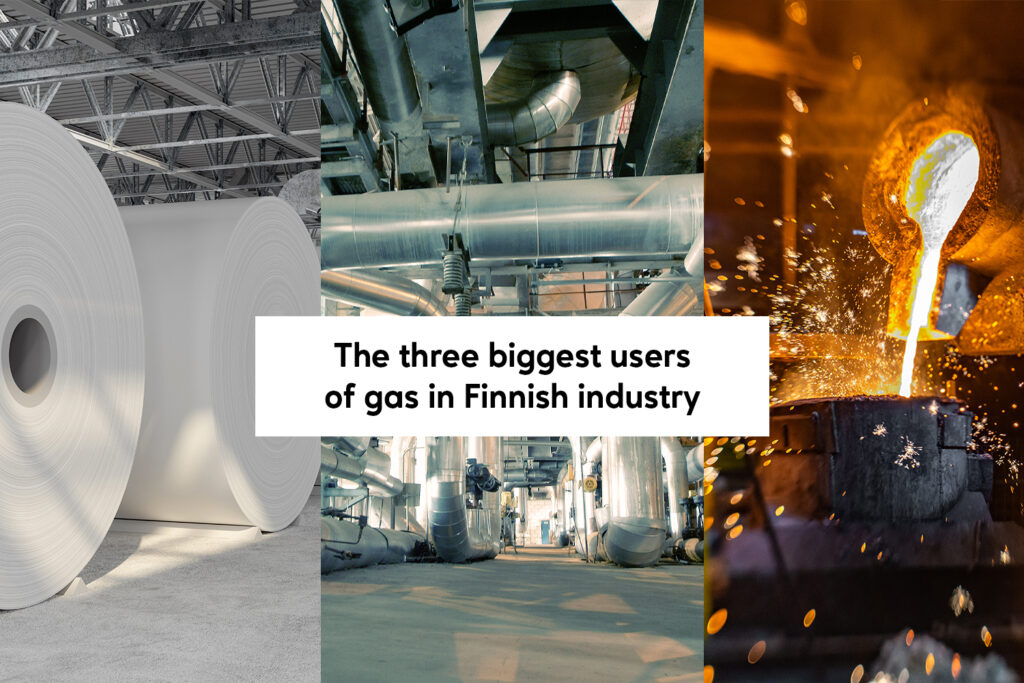
Gas is a strong driver of traditional industry. The forest industry, the chemical industry and the metal industry are the biggest users of gas in Finnish industry – and finding a substitute for gases is far from easy. Gases are used as raw materials and fuels in industrial processes that are very difficult – if not impossible – to electrify with the help of modern technology. The gas sector itself, on the other hand, is undergoing a transformation as clean gases gain ground.
The king of gases is – at least for now – natural gas. In 2024, 14.0 TWh of gas were consumed in the gas network area in Finland. By comparison, for example, only about 1%, or 130 GWh, of biogas was injected into the transmission network over the same period. Correspondingly, the amount of electricity consumed is about six times that of gas, i.e. just under 100 TWh.
Gas has really many uses:
– In the forest industry, gas has traditionally been used to dry paper – and the industry continues to see it as an unbeatable alternative. Gas also produces the energy needed by the facilities.
– In metal processing, gas is suitable for many process steps from smelting to tempering.
– In the chemical industry, gases are used, for example, to make petrochemical processes more efficient. A particularly strong application is in hydrocarbon processing and the fertiliser industry.
– In the glass industry, gas is an excellent commodity because glass requires high temperatures before it can be shaped.
– In the food industry, gases are used to heat and dry foodstuffs and, if necessary, to ensure a sterile production process through high temperatures.
Other industrial applications suited for gas can be found, for example, in the pottery industry, the asphalt industry, laundries and powder coating shops.
Gas is also a scalable raw material: gases are used by small artisan workshops as well as huge refineries.
Clean hydrogen can help to reduce carbon dioxide emissions in the steel industry
The steel industry is one of the emerging industries in the new use of gases. Today, the steel industry is one of the most polluting industries, accounting for 7-9% of global CO2 emissions. Steel produced using clean hydrogen – i.e. carbon neutral – can significantly reduce the global carbon balance.
Clean hydrogen is expected to be a sustainable raw material and fuel for other industrial sectors as well.
Besides renewable biogas, the emergence of clean gases also involves synthetic methane (e-methane), which is identical in structure to natural gas. However, synthetic methane outperforms conventional natural gas in meeting CO2 targets because it is produced using not only pure hydrogen but also carbon dioxide captured from flue gases or the air.
E-methane can be used in exactly the same applications as natural gas and biogas – and when liquefied, it is also suitable for the same applications as liquefied natural gas (LNG) and liquefied biogas (LBG, bio-LNG). This is why e-methane can be transported using the existing infrastructure (trucks, ships, pipelines).
The production of synthetic methane – and other clean gases – in the gas network area could increase 20 or 30 times in a few years. In Finland, demand for renewable gas is high, and in addition to national production, large quantities of biomethane are also imported from other European countries, especially Denmark.
Gas is also used in heat production and for the needs of the electricity market, especially to balance weather-dependent renewable energy production
Gas is also suitable for centralised heat production in district heating networks. Gas-fired heating plants make it possible to supplement CHP production in very cold weather. Heating plants ensure the supply of heat during peak demand, power plant disruptions and maintenance outages, among other things.
Recent years have seen an increase in the importance of gases in the electricity market due to their excellent balancing capacity. While there has been strong growth in the share of wind and solar power in electricity production, balancing these weather-dependent sources of energy production requires balancing capacity for times when the wind is not blowing and the sun is not shining. This is where gas engines have an important role to play.
This reserve capacity is also available very quickly: it takes just a few minutes to start up and adjust gas-engine power plants..
Now should we forget that thousands of homes in Finland are heated by gas – and many chefs swear by gas cookers.
—
Why is gas worthwhile?
Gas is an ideal fuel, especially where high temperatures and rapid controllability are required – and where contaminants such as sulphur compounds are to be avoided in the power generation or industrial processes.
Text: Sami J. Anteroinen
Image: Otavamedia
Read more:
Gas is an important fuel in UPM’s operations
Gas provides regulating power – and much more – Gasgrid Finland