
Gasgrid met with MBA students from Imperial College Business School in Espoo as part of a study programme focused on corporate climate actions. The meeting provided students with the opportunity to learn about Finland’s energy system, the clean gas market and the development of the hydrogen economy – as well as to hear directly from Gasgrid’s experts about how the company is building a more sustainable future.
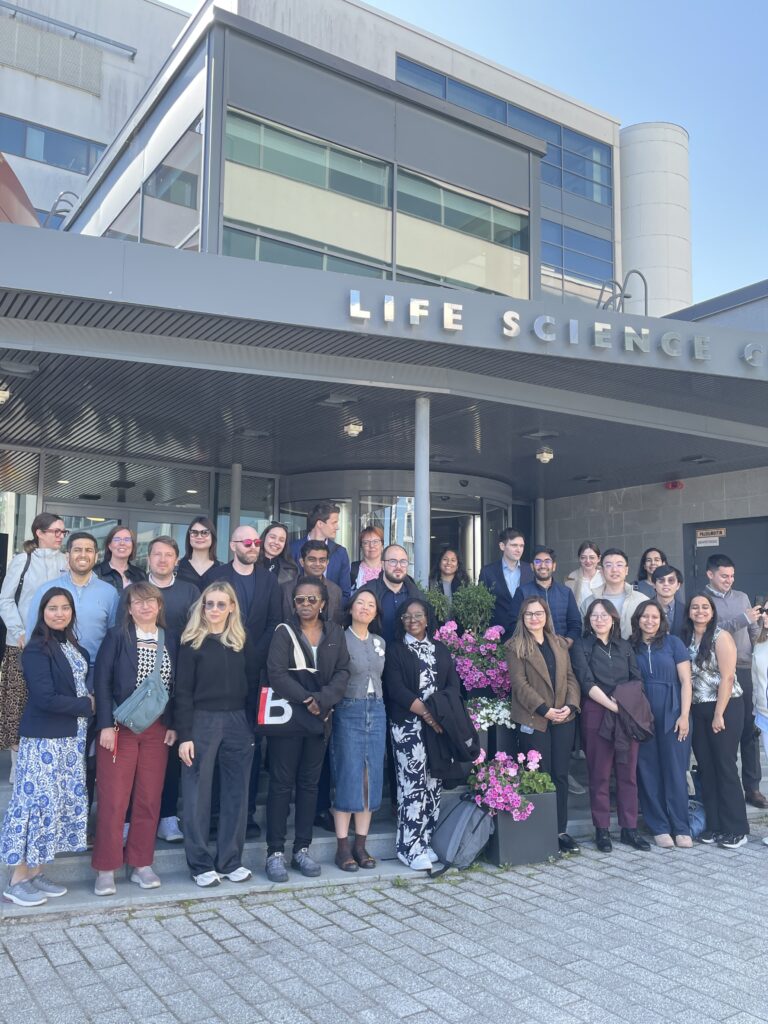
Gasgrid organised a meeting for students from Imperial College Business School in Keilaniemi, Espoo, in June. The group consisted of over 40 Master of Business Administration (MBA) students, many of whom had prior experience in the oil and gas industry. The group travelled to Helsinki as part of Global Experience Week – How Business Addresses Climate Change, a programme that examines how companies around the world respond to the challenges of climate change. After Helsinki, the group headed to Copenhagen for a field trip.
In addition to Gasgrid, the student group met with other Finnish industry actors. The students wanted to meet with Gasgrid to gain a deeper understanding of the role of natural gas in the energy transition, the impacts of cross-border energy systems and Gasgrid’s actions to promote sustainable energy solutions.
Gasgrid’s student collaboration expands
Gasgrid actively promotes collaboration with universities and educational institutions across various sectors.
“We regularly receive inquiries from students, student organisations and educational institutions regarding, for example, thesis projects and participation in various events. Last November, we participated in Gas Day, organised by energy technology students’ Energy Engineering Club, together with Gasum, Auris Energia and Finnish Energy. The meeting with Imperial College Business School also helped strengthen the international dimension of our student collaboration,” says Gasgrid’s Head of Communications, Marjaana Kivioja.
Gasgrid has had a very eventful history
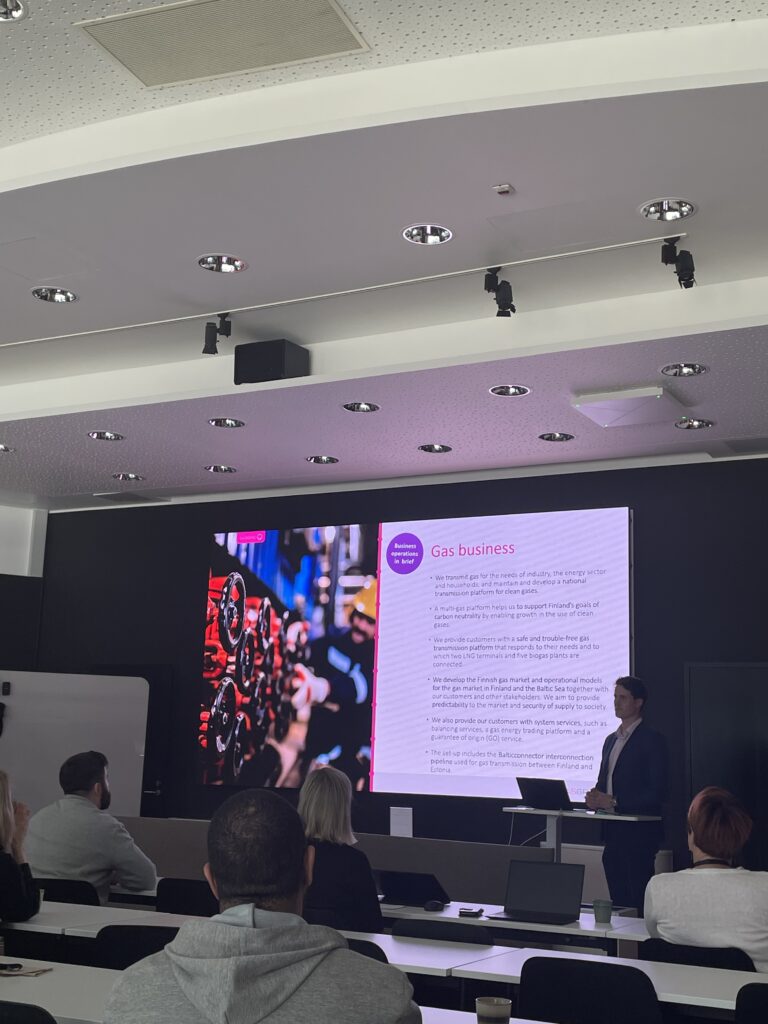
Keynote speakers Mika Myötyri, Head of Gas Market and Customers, Heli Haapea, Service Manager of the Gas Market Unit, and Heli Virkki, Head of Hydrogen Valley Development and Customer Projects, shared their insights about Gasgrid’s operations and future energy solutions.
Myötyri reflected on Gasgrid as a company and its approximately five-year journey marked by major market shifts.
“The period has included the opening of the Finnish gas market to competition, the commercial commissioning of the Balticconnector pipeline connection, the European energy crisis and the resulting increase in natural gas prices, the disengagement from Russian pipeline gas and the record-fast commissioning of the Inkoo LNG terminal, the damage to the Balticconnector pipeline and the successful repair work on the pipeline, as well as the significant acceleration of Gasgrid’s hydrogen development,” he listed.
Despite the changing operating environment, Gasgrid has provided Finland’s industry, the energy production sector and companies with safe, reliable and cost-effective gas transmission. In introducing the role of gas infrastructure to students now and in the future, Myötyri stated that “predictability is very important for market participants.” Gasgrid is committed to strengthening this predictability in all its decisions regarding the gas transmission network.
The future of the clean gas market
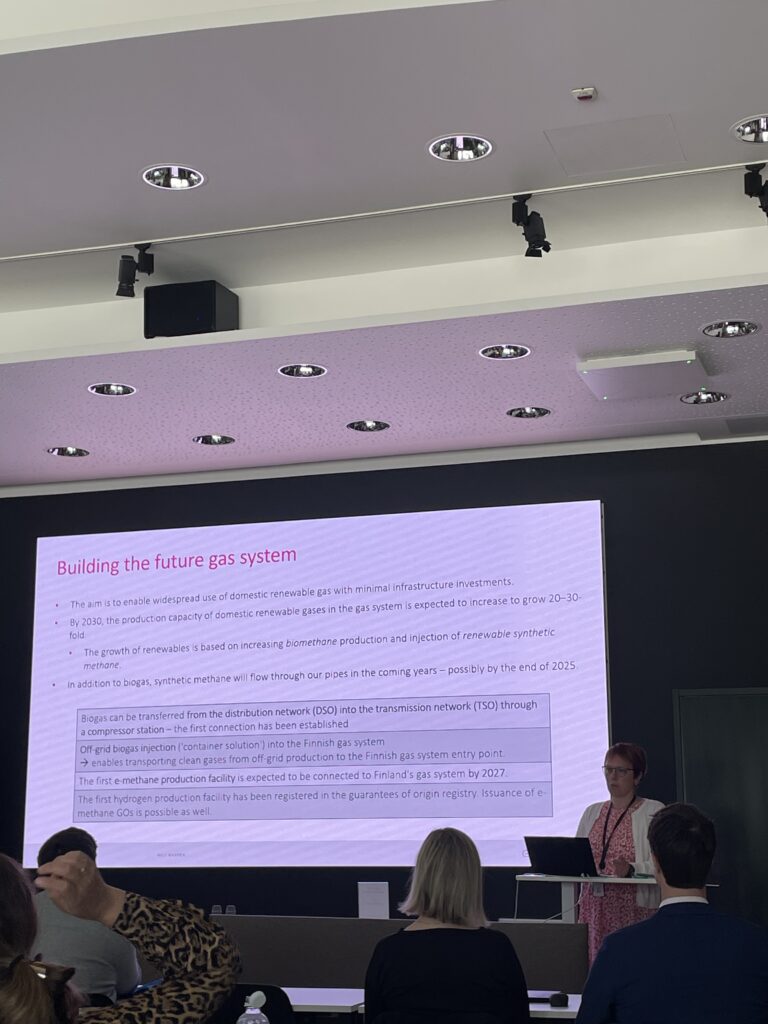
Myötyri’s presentation was followed by a speech by Heli Haapea on the future of the clean gas market in Finland, particularly from the perspective of domestic renewable gases and the guarantee of origin system. Haapea stressed that Gasgrid’s “aim is to enable widespread use of domestic renewable gas with minimal infrastructure investments.” By 2030, the production capacity of domestic renewable gases is expected to increase 20 to 30 times in the gas system. The growth of renewable gases is based on the production of biogas and synthetic methane.
Haapea also spoke about Gasgrid’s role in the guarantee of origin (GO) system. Gasgrid operates in Finland as the administrator of the gas GO register and is authorised to issue both national and European EECS (European Energy Certificate Systems) GOs for gas and hydrogen production facilities.
“A guarantee of origin is the only way to ensure that clean gases, such as biogas and hydrogen, have been produced from renewable energy sources. Last year, most of the gas GOs imported to Finland came from Denmark, and the import of GOs has generally continued to grow this year as well,” she said.
Finland has a billion-euro investment potential in the hydrogen economy
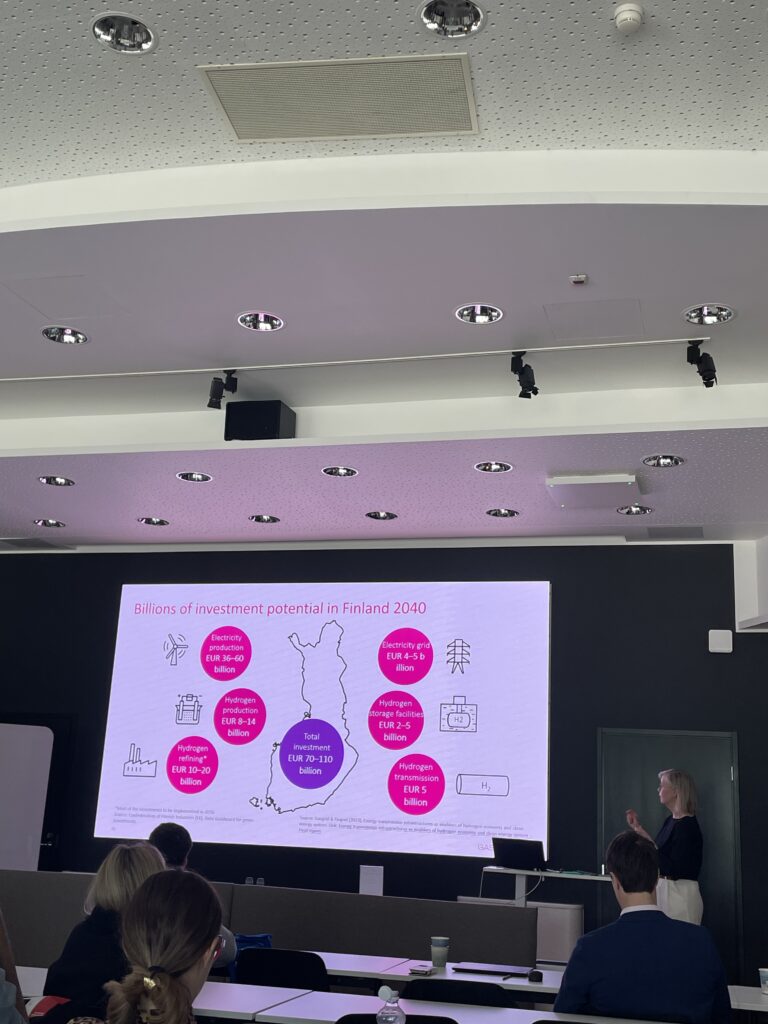
In the final keynote speech of the event, Heli Virkki focused on the development of the hydrogen economy and infrastructure in Finland, describing the hydrogen economy’s investment potential as promising. A hydrogen economy built on hydrogen infrastructure can create economic impacts of approximately EUR 70–110 billion in investments in Finland.
“We support Finland on its way to becoming the engine of the European hydrogen economy,” said Virkki, summing up Gasgrid’s role as the driver of the national hydrogen economy.
Hydrogen infrastructure that enables the scaling of hydrogen economy is being developed simultaneously on multiple levels – the national hydrogen network, regional hydrogen networks, and hydrogen infrastructure projects in the Baltic Sea region are all part of the overall scheme. At the end of Virkki’s presentation, the students had the opportunity to see the steps involved in building the national hydrogen infrastructure. The development of hydrogen infrastructure is a gradual process, from the detailed planning of the hydrogen pipeline and the development of a hydrogen market model to the actual investment decision and ultimately to the construction of the hydrogen transmission infrastructure.
“Gasgrid’s goal is to have an operational hydrogen market and infrastructure in place in Finland in the first half of the 2030s,” stated Virkki.
Gasgrid’s role in Finland’s energy system sparked lively discussion
At the end of the event, students had the opportunity to ask questions. The discussion was lively and engaging, and the questions put to our experts covered a broad range of topics, including gas price fluctuations, the role of the transmission system operator in the gas system, the prerequisites for investment decisions in the hydrogen infrastructure and Finland’s competitiveness in the hydrogen economy. Students contemplated how Finland stands out in the hydrogen economy compared to other countries and regions.
According to Virkki, “a clean energy system and strong energy infrastructure, affordable electricity prices, a functioning electricity market and significant availability of biogenic CO2” are what make Finland an attractive environment for hydrogen economy investments.
We thank the students of Imperial College Business School for their thoughtful questions and participation!