
The year 2025 has been a period of stabilization for Finland’s gas market. Since the repaired Balticconnector interconnector was commissioned in April 2024, the market has remained stable. The role of gas infrastructure as an enabler and implementer of balancing power production has become more prominent, while the role of gas in heat generation has decreased due to the growth of electric boiler capacity.
In the industrial segment, gas continues to play an important role, but the base load of gas consumption—primarily from industrial use—has declined in the second half of the year. The winter season began calmly in Finland’s gas market. The peak gas demand of the winter season 2025-2026 up to November 21 has been 75 GWh/day, recorded on November 18.
Demand for biomethane in Finland has remained high, and in addition to domestic production, significant volumes are imported, particularly from Denmark.
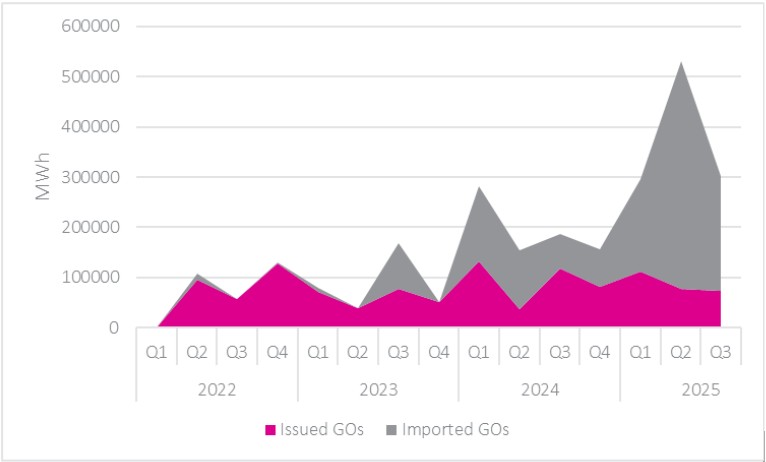
Guarantees of Origin (GOs) issued in Finland and imported GOs by quarter.
Over the past year, Gasgrid has increasingly engaged in discussions with potential new connecting parties to the gas transmission network who are planning to inject bio- or e-methane into Finland’s gas system or use gas primarily for electricity generation. In addition, Gasgrid is planning a 14-kilometer interconnector between Tampere and Kangasala to link a local industrial area to the transmission network. According to the plan, construction of the pipeline is scheduled for 2027, with completion targeted for 2028. Therefore, the outlook for gas network development remains positive, even though annual gas consumption volumes have been declining.
Gases role as a stabilizer in electricity markets has increased
In May 2025, the Ministry of Economic Affairs and Employment published its final report introducing a model aimed at ensuring sufficient weather-independent electricity generation in Finland. The identified technical production needs will be competitively tendered on a technology-neutral basis among market participants. The report emphasizes the importance of gases in securing electricity generation and increasing flexibility in energy markets.
According to Gasgrid’s assessment, the current gas market and infrastructure can provide technically well-suited solutions for such tenders. The transmission system’s capacity enables reliable and swift connection of new customer sites, such as gas engine power plants, to the network. New plants could be operational within 2–3 years.
Gas engine power plants as part of Finland’s energy system are a concrete example of deepening sector integration between gas and electricity markets. The growth of weather-dependent renewable electricity generation increases the need for flexible, weather-independent power production—especially during periods when the sun does not shine or the wind does not blow sufficiently. In these moments, gas plays a key role in mitigating price spikes in the electricity market, and fast-adjusting gas engines are excellent electricity producers.
The growth of domestic renewable gas production and increased imports have improved the conditions for using renewable gases in gas engine power plants alongside natural gas.
EEX gas exchange started operations in Finland’s gas market
The introduction of the EEX exchange brought a significant change to the Finnish gas market in September. Trading moved from the GET Baltic platform to the Europe-wide EEX platform, which more closely integrated Finnish and Baltic markets into European gas trading. The new exchange offers market participants products for day-ahead (spot) trading and futures trading. In addition, EEX developed a service equivalent to GET Baltic’s previously offered implicit capacity allocation model, enabling cross-border trades directly through the exchange platform.
Security of Supply gas remained excellent
Security of supply has remained high throughout the year, and our customers have received gas reliably at their points of use. The transmission infrastructure has been almost fully available to the market, although Balticconnector’s transmission capacity was restricted in June and late October due to maintenance work in Estonia and Latvia. During these periods, Finnish gas demand was mainly covered through LNG terminals connected to the network.
In August, a technical anomaly was detected in a pipeline near Hamina, requiring immediate repair and temporary shutdown. The Hamina LNG terminal ensured physical gas transmission to a critical delivery point during the work, while Gasgrid utilized the flexibility provided by pipeline energy storage to minimize customer impact.
Gasgrid continued close cooperation with Baltic transmission system operators to maintain a liquid and competitive regional market, guided by harmonized rules at an appropriate level. In addition, Finnish and Baltic operators coordinated maintenance and repair work required for a functional and secure gas infrastructure, aiming to schedule work at times with minimal market impact.
Gas transmission tariffs in 2026
During the current year, we completed the EU regulation-based process for gas transmission tariff structure, including public consultations and regulatory procedures. Gasgrid proposed a new tariff component—a capacity subscription charge—which, once approved by the Energy Authority, will take effect on January 1, 2026.
The new component reflects changes in the use of transmission services and infrastructure in recent years, particularly in the energy production segment. Its goal is to balance costs across customer segments relative to the service and value provided by the infrastructure and to increase tariff stability.
Another remarkable change in transmission service price list is 100% discount on entry capacity charges for renewable gases injected into Finnish gas system and 75% discount for low-carbon gases injected into the system.
These discounts aim to support clean gas market development and enhance Finland’s attractiveness for investments in renewable and low-carbon gas production facilities, in addition to meeting regulatory requirements determined by the amended EU Gas Package.